October 29, 2026
Where to Buy Digital Signage Displays That Actually Last
A buyer's guide to sourcing commercial digital signage displays, covering AV distributors, manufacturer direct, retailers to avoid and what to check before you pay.
By Timothy Carter

Most operators pick a signage software vendor first, then grab whatever TV is on sale at the warehouse club the week before launch. Six months later the panel in the lobby has a dim stripe across the top, the drive-thru screen has gone yellow in the sun, and the manufacturer refuses the warranty claim because the serial number shows commercial use on a consumer SKU.
The screen matters as much as the software running on it, and the channel you buy from decides what warranty you actually get, how fast a dead unit is swapped, and whether the panel is rated for the hours you plan to run it. There are five realistic places to source commercial displays in the US. Each one is good for a specific kind of operator and bad for the others.
So where do you actually place the order?
Why the Channel Decides the Warranty
Before the where, the what. A consumer TV and a commercial display look identical on a showroom floor and differ in every spec that matters for a screen that runs all day. Consumer panels are built for roughly four to six evening hours, while commercial units carry a 16/7 or 24/7 duty-cycle rating, portrait support that does not void the warranty, and ports like RS-232 and LAN for remote control.
The warranty gap is the one that bites. A consumer TV warranty is typically one year and is voided outright by commercial use, which the manufacturer figures out from the serial number and the install photos the moment you file a claim. A commercial panel bought through an authorized channel usually ships with three years of on-site coverage. Samsung's business TV lineup, for example, carries a 16/7 runtime rating with a three-year commercial warranty on the BET-H, BEB and BEA Series, with true 24/7 operation reserved for the professional QM-series signage models.
That three-year number only holds if the seller is authorized by the manufacturer. A gray-market import of the same SKU, sold on a marketplace at a tempting discount, often carries no US warranty at all. The channel is the warranty.
Authorized AV Distributors Are the Default Answer
For most multi-site operators, the right starting point is an authorized pro AV distributor. These are the companies the manufacturers themselves sell through: Exertis Almo, TD SYNNEX, Ingram Micro and a handful of regional players. Almo Pro AV runs five regional distribution facilities across the US with over 2.5 million square feet of warehouse space, which is why a Samsung or LG commercial panel ordered through one of their resellers usually ships inside the week.
Distributors do not sell direct to end users in most cases. You buy through one of their authorized resellers, who places the PO with the distributor and handles freight, install coordination and warranty claims on your behalf. The practical upside: real duty-cycle SKUs, documented three-year warranties, stock you can actually ship, and a human you can call when a panel arrives DOA.
What distributors are bad for: single-screen buys from a one-location business. Most resellers want a project of some size, and the paperwork load for a single 43-inch panel is heavier than the margin justifies. If you are opening one coffee shop with one menu board, a distributor-fed reseller is overkill.
Manufacturer Direct Works for Large Rollouts
Samsung, LG, Sony, Philips, NEC and Panasonic all have direct enterprise sales teams. If you are rolling out fifty screens or more across a chain, calling the manufacturer first is reasonable. You get volume pricing, named account management, and sometimes custom warranty terms that extend the standard three years.
Smaller orders get politely redirected to a distributor or reseller. That is not a snub, it is how the channel is structured. Manufacturer direct also means you own the install logistics, the mounts, the players, the cabling and the day-two support, so unless you have an internal AV team or a signage partner handling the rest, direct buying creates more problems than it solves.
One underrated advantage of going manufacturer-first on a large project is OS lifecycle. Samsung committed in 2024 to seven years of free Tizen upgrades starting with 2024 models, which, for a commercial Tizen-based signage panel, means the embedded player can plausibly keep receiving security updates until around 2031. That matters when you are specifying hardware you will not touch again for five years.
Pro AV Integrators Handle the Whole Install
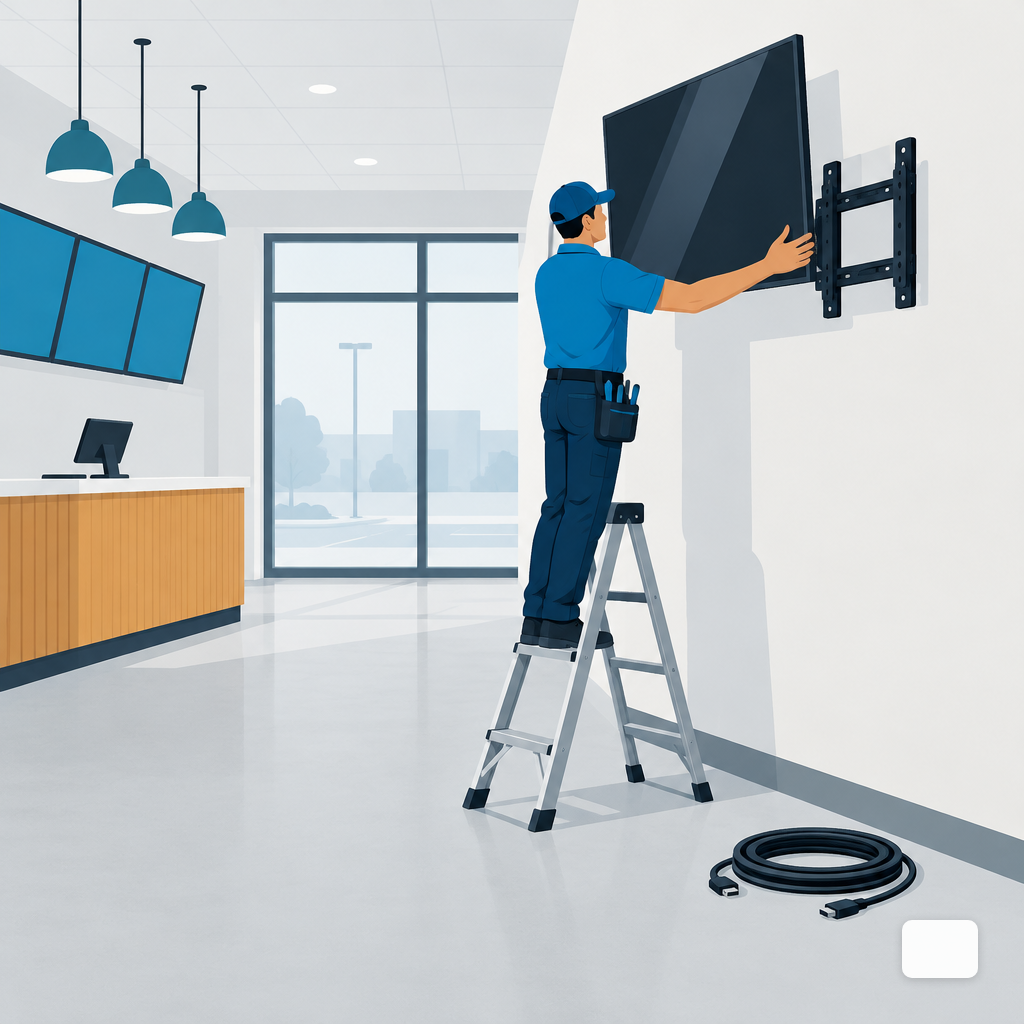
A pro AV integrator sources the displays, installs them, and services them. For a drive-thru with four weather-rated outdoor panels, a lobby video wall, or any job that involves structural mounts, conduit runs or network drops, this is the channel that keeps the project from stalling.
Integrators carry authorized reseller status with the major display brands, so the warranty flows through them. They also handle site surveys, which is the step most self-installing operators skip and then regret. The downsides: higher total project cost, longer quote cycles, and timelines measured in weeks rather than days.
If the job involves an LED video wall rather than LCD panels, the timeline stretches further. The honest planning numbers from one installer:
If you need the screen on in two weeks, an LED wall is not the project. A conventional commercial LCD panel from a distributor-fed reseller is.
Refurb Specialists Can Save Real Money if You Are Careful
A legitimate refurbished commercial display market exists, mostly in interactive panels and large-format signage pulled from corporate deployments. The pricing is attractive and the environmental argument is real. The warranty question is where most operators get burned.
An industry survey found that most buyers expect at least a 50 percent discount on refurbished signage hardware, and discounts under 20 percent attract almost no interest. The chart below shows how operators actually price the risk:
Buy refurbished only from a seller who publishes the remaining warranty term, the panel's prior operating hours if available, and a return window measured in weeks rather than days. Avoid auction-site listings where the condition grade is "working" and nothing else. For displays that will run menu boards or any revenue-driving content, the risk-reward on refurb usually does not pencil out unless the discount is deep and the warranty is real.
Big-Box Retail Is Where Most of the Pain Starts
Costco, Best Buy, Amazon and the warehouse clubs sell consumer TVs. That is their job and they are good at it. They do not sell commercial displays in any meaningful quantity, and the few business-branded SKUs they carry are usually hybrids with a one-year warranty that still excludes signage use.
For a church sanctuary that uses a screen for ninety minutes on Sunday morning, a consumer TV from a big-box store will survive. For a QSR menu board on from six AM to eleven PM, it will not. Typical MTBF for commercial LCD modules runs 30,000 to 70,000 hours, or roughly three to seven years of continuous use. A consumer backlight at the same duty cycle shows visible degradation inside eighteen months.
If the application is a storefront window where sunlight hits the glass, the SKU question gets stricter. Samsung's OM-series window displays deliver 3,000 to 4,000 nits specifically engineered for installation behind glass, with the OM75A reaching 4,000 nits at the top of the lineup. A 400-nit consumer TV in a south-facing window washes out by eleven AM. No channel decision fixes a panel that was never spec'd for the environment. For more on this, our rundown of digital signage hardware statistics covers the brightness and lifespan numbers in more detail.
Match the Channel to the Job
A single-location restaurant with one menu board can buy a Samsung BEA or LG UL3J-series panel from an authorized online reseller, add an Android player, and be running within a week. A ten-location dental group adding lobby screens should call a regional AV integrator and get a quote that includes mounts and install. A hundred-location QSR chain should start the conversation at Samsung or LG direct and let the manufacturer bring the integration partner.
The software layer is the easier decision once the hardware is sorted. A browser-based player like the one DigitalSign runs on works on commercial Tizen, webOS, Android, and plug-in sticks, which means the display channel decision does not lock you into a signage vendor. If you want a longer checklist before you buy, our list of questions to ask a signage vendor covers the player side the display spec usually ignores. And once the panels are mounted, our walkthrough of what breaks in the first 90 days is the checklist to run before the go-live date.
The One Shortcut That Usually Backfires
The sentence that leads to the yellowed drive-thru screen is almost always the same: "We can save a few hundred dollars per screen if we just buy consumer TVs from the warehouse club." That math only works if nothing fails. Once a consumer panel fails in a commercial install, the replacement cost, the install labor, the downtime and the credibility hit with the operator who approved the shortcut all come due at once.
Pick the channel that matches the project size. Verify the SKU is a true commercial model with a published duty-cycle rating. Confirm the three-year commercial warranty in writing before the PO goes out. Then spend your attention on the content on the screen, which is where the return on the whole project actually lives.
Timothy Carter
Chief Revenue Officer
Timothy Carter is a digital marketing industry veteran and the Chief Revenue Officer at DigitalSign. With a career spanning over two decades in the dynamic realms of SEO and digital marketing, Tim is a driving force behind revenue strategy. With a flair for the written word, Tim has graced the pages of renowned publications such as Forbes, Entrepreneur, Marketing Land, Search Engine Journal, and ReadWrite, among others. At DigitalSign he writes about the commercial side of the screens a business already owns: what a menu board is worth when it changes with the daypart, what a promo that kept running a week past its end date really costs, and why the signage budget an owner argues about is usually a content problem rather than a hardware one. Beyond his professional pursuits, Tim finds solace in the simple pleasures of life, whether it's mastering the art of disc golf, pounding the pavement on his morning run, or basking in the sun-kissed shores of Hawaii with his beloved wife and family.


